
Most AI image generators botch complex hand details, output fuzzy text, or break character consistency with even minor edits. Creators often waste hours refining prompts, only to get flawed, inconsistent results.
OpenAI’s new GPT Image 2.5 fixes many of these issues, with improved spatial awareness, faster generation speeds, and crisp, accurate text rendering.Still, many creators seek better alternatives. Its closed-source ecosystem comes with high API costs, tight credit limits, and restrictive safety filters that stifle creativity and slow down workflows.
Platforms like a1.art have emerged as premium alternatives, delivering sharper renders, diverse styles, and true-to-life realism without tedious prompt tuning.
This guide breaks down GPT Image 2.5’s benchmarks, pricing and real-world limits, and compares top competing AI visual tools for efficient creative production.

What is GPT Image 2.5? Release Date and Core Breakthroughs
Precision In-Image Typography: Older AI models always messed up text in images, turning clear English words into unreadable gibberish. GPT Image 2.5 solves this problem perfectly, generating clean, readable text naturally on posters, product labels, banners and other visual assets.
Localized Inpainting & Multi-Turn Consistency: The model can lock in core details including character features, lighting directions and background elements through multiple rounds of edits. You can tweak specific parts of an image freely without ruining the overall composition or other existing details.
Enhanced Spatial Logic: It now understands complex positional instructions far more accurately. For example, detailed prompts like “put a ceramic mug next to a vintage typewriter, with its reflection showing in a brass mirror” can be executed precisely with correct context and spatial relationships.
Start your art journey with a1.art.
Why You Need Alternatives: Finding the Right Visual Engine
GPT Image 2.5 works fine for basic image tasks, but professional creative projects need more artistic freedom, wider stylistic options, and better control over output quality.
Top Reasons Creators Switch to Alternative AI Platforms
-
Broader Style Diversity: OpenAI’s models tend to stick to a generic corporate illustration or sleek CGI look. Creators often need more unique styles,from cinematic film grain and hyper-realistic photography to watercolor and anime.
-
Cost Efficiency: For high-volume work like e-commerce product shots, video storyboards, and marketing visuals, OpenAI’s per-image API pricing gets costly fast with its inflexible billing structure.
-
Direct Fine-Tuning & Control: Alternative platforms let you freely adjust lighting, aspect ratios, style LoRAs and seed locking, with no restrictive prompt filters limiting your tweaks.
Click the image to instantly generate the exquisite AI image you want⬇️

The Ultimate Solution: Why a1.art Delivers Superior Results
When it comes to speed, flexibility, and photorealistic quality, a1.art is a top-tier alternative to tools like GPT Image 2.5. Built specifically for creators, marketers, and artists, it pairs powerful diffusion models with ready-to-use, user-friendly style workflows.

Why a1.art Outperforms the Competition
-
Faster Generation Latency: Powered by high-performance GPU clusters, a1.art processes prompts quickly with almost no waiting time, letting you keep your creative pace uninterrupted.
-
Ultra-Crisp Visual Clarity: With advanced upscaling and fine detail optimization, all generated images have sharp edges, vivid contrast, and no blurry compression artifacts.
-
Natural & Photorealistic Skin Textures: No more fake, waxy-looking skin. The platform renders realistic pores, natural light penetration, and lifelike reflections for true cinematic quality.
-
Zero Anatomical Distortion: Custom structural correction models eliminate classic AI flaws such as deformed hands, extra fingers, and unnatural limb poses, producing images ready for immediate use.
-
Smart Non-Occluding Composition: Its layout engine arranges every element intelligently. Text, foreground objects, and background details fit perfectly together without overlapping or blocking each other.
-
Hyper-Aligned Aesthetic Appeal: Tuned by professional designers, a1.art’s built-in presets offer well-balanced layouts, harmonious colors, and trendy, eye-catching visual effects.
Step-by-Step Guide: Generating High-Impact Visuals on a1.art
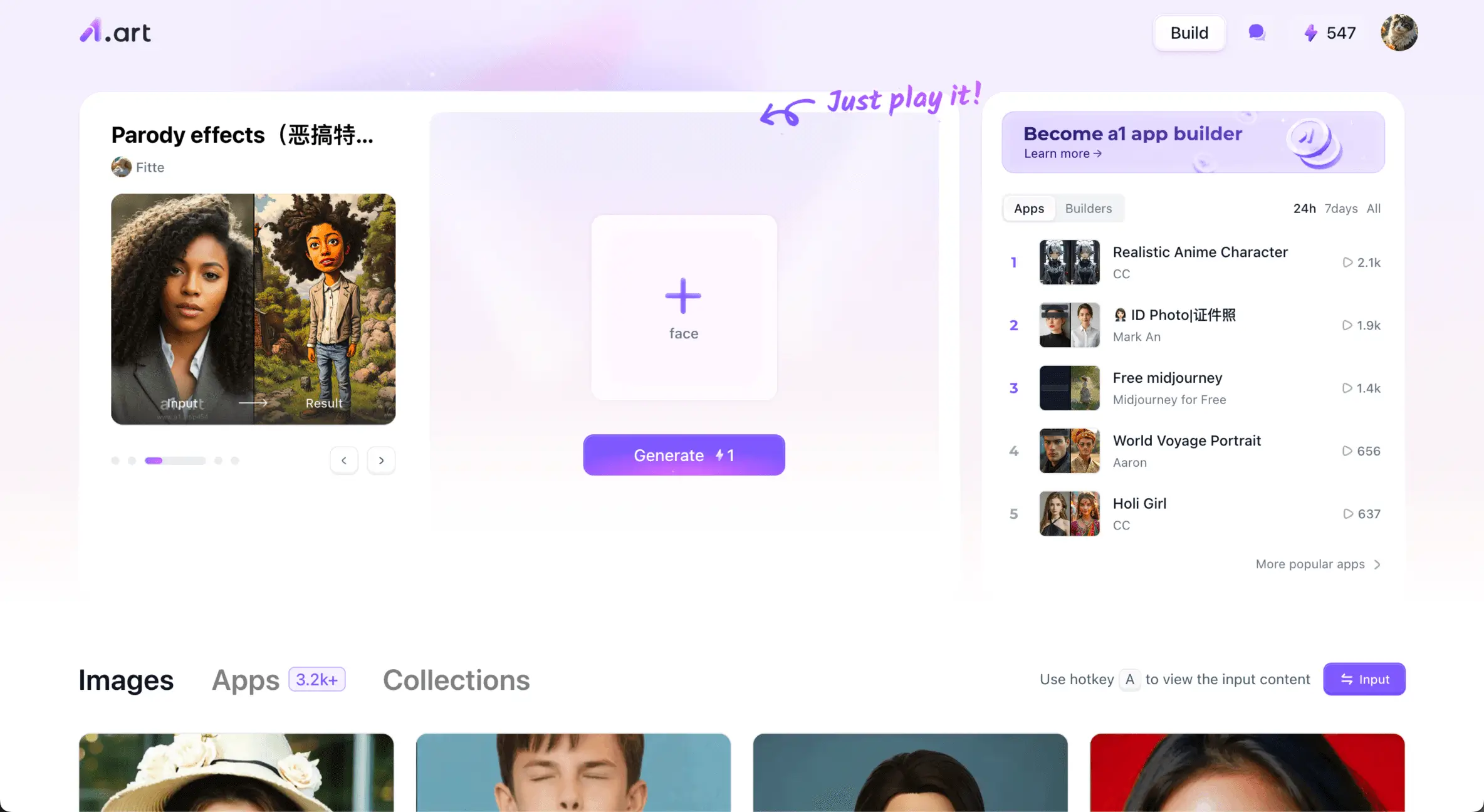
a1.art offers a wide range of filters in various styles and formats that you can use to generate the images you want. Its advantage over GPT lies in the availability of numerous ready-made options, making it incredibly convenient,especially for beginners. Below, I’ll show you how to use a1.art to create images you’ll be happy with.

Step 1: Open a1.art and scroll down to the filter collections section
There are actually many collections available here; I can only show two due to page constraints, but in reality, there are far more. Each collection contains different types of filters, so you can take your time browsing through them,simply click on any that interest you to start using them.

Step 2: Start generating the AI images you want
Let’s take a random filter as an example,say, "Get New Looks." When you click on it, you’ll see a preview image of the filter in the top-left corner and examples of creations made by other users using this filter in the bottom-left. On the right side is the generation area; simply upload an image, click the "Generate" button below, and then wait,it takes about 2–3 minutes. It’s really that simple, isn't it?

Step 3: Process the AI-generated image
Once the generation is complete, you can preview the image to see if it meets your expectations. Personally, I find the generated images stunning; the lighting on the figures and other details are perfect and look completely natural.You can also publish it to the community yourself or download it locally.

Pricing & Access: Is There a GPT Image 2.5 Free Tier?
Understanding the commercial cost structure is vital for scaling visual production pipelines. Creators frequently ask if there is a gpt image 2.5 free plan or trial option available.
-
Subscription Tier: Accessing the model via ChatGPT Plus or Enterprise plans requires a monthly subscription (typically starting at $20/month), subject to strict hourly message caps.
-
API Usage Pricing: Developer API billing operates on a tiered image-resolution matrix, where the standard gpt image 2.5 price ranges from $0.04 to $0.12 per generated output depending on quality settings (Flare vs Sunburst) and resolution step.
-
Free Access Constraints: OpenAI does not currently offer a dedicated, unrestricted gpt image 2.5 free tier. Non-paying users receive extremely limited trial credits or are downgraded to legacy models during peak traffic hours.
Conclusion
Picking between GPT Image 2.5 and modern tools like a1.art all depends on your project needs, budget, and visual quality goals.GPT Image 2.5 is a solid upgrade for OpenAI’s multi-modal toolkit, but it falls short for professional work. It has fixed pricey subscription costs, inconsistent generation speeds across its engines, and a generic, artificial default art style.
Platforms like a1.art fix these pain points. They deliver faster results, sharper imagery, and far more realistic human renders,perfect for high-quality, conversion-focused visual content.
Ready to upgrade your creative workflow? Try a1.art today to feel the difference in speed, clarity, and creative freedom.
FAQs
What is the main difference between GPT Image 2.5 Sunburst and Flare?
Sunburst is built for maximum image precision and complex details, while Flare is optimized for ultra-fast generation and low-latency workflows.
Is GPT Image 2.5 free to use?
No, there is no completely free tier.Access requires a ChatGPT subscription or pay-per-image API credits.
Why should I choose a1.art as an alternative?
a1.art offers faster render speeds, superior skin textures, zero anatomical distortions, and hundreds of ready-to-use style presets without prompt complexity.
Read more
- Best Hot AI Video Generator Apps to Create New Videos from Photos
- How to Create the Viral Radha Rani AI Photo Trend in 2026
- 15+ Ganesha AI Video Prompts for Ganesh Chaturthi Reels in 2026
- How to Get AI Photos of Yourself: An Easy Step-by-Step Guide
- 20+ Ganesh Chaturthi AI Prompts for Festive & Devotional Photos in 2026
- Da Nang Festival 2026: Ultimate Guide to Dates & Events
- Unlock 20+ Onam AI Prompts for Traditional Kerala Photos in 2026
- Best Prompt Hero AI Alternatives for AI Prompts and Image Generation
- How to Create Childhood vs Present AI Photo?
- Dreemy AI Review 2026: Is It Safe, Free and Worth It?
Written by

a1.art
Published on
Sep 9, 2026
Share article


