

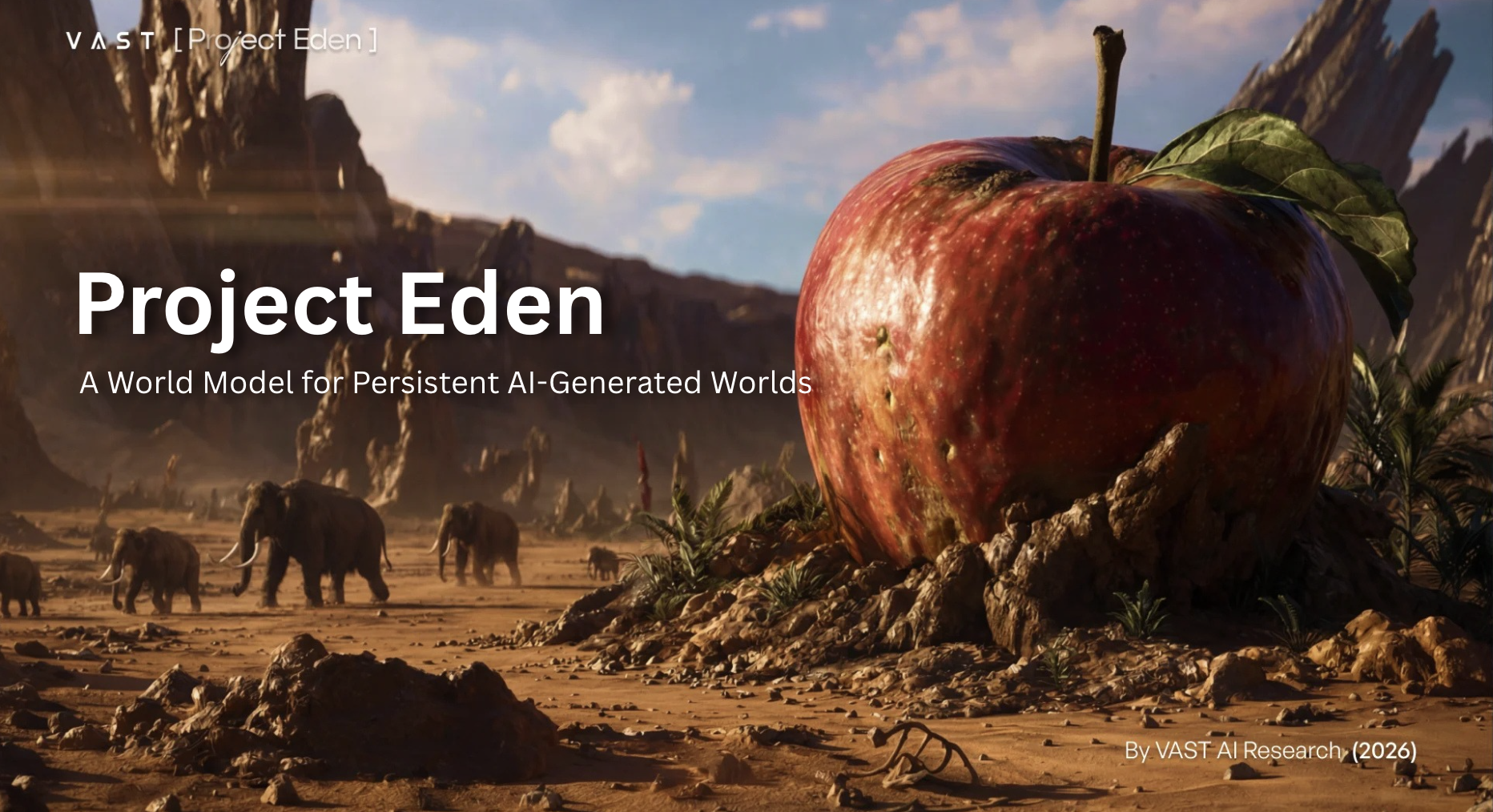
Partner Spotlight: VAST AI Research Introduces Project Eden, a World Model for Persistent AI-Generated Worlds
AI creation is evolving quickly. In just a few years, generative AI has moved from image generation to video creation, AI-powered 3D modeling, and increasingly interactive forms of digital content. As these tools become more powerful, creators are beginning to look beyond single images or short clips toward richer digital environments that can be explored, changed, and reused.
As part of A1 Art's broader creative AI ecosystem, we are highlighting a recent research update from VAST AI Research, the team behind Tripo3D. VAST AI Research has introduced Project Eden, a world model research preview designed to explore persistent, editable, and interactive AI-generated worlds.
For A1 Art users, this release is worth watching because it points to a broader direction in creative AI: moving from generating visual outputs to building worlds that can remember changes, support interaction, and remain consistent over time.
Why World Models Matter
Generative AI has spent the past few years getting better at producing what we see: text, images, videos, and 3D assets. World models move one layer deeper. They are not only about visual output, but about the environment behind it — what exists, what changes, and what remains consistent over time.
A world is not just what appears on screen. It has objects, locations, actions, memory, rules, and consequences. If a fire is put out, it should stay out. If a mark is left on a wall, it should remain there. If an object moves outside the camera view, it should still exist in the same world. And if multiple users enter the same environment, they should not be interacting with separate visual simulations, but with one shared underlying reality.
That is the core challenge Project Eden is designed around: maintaining the state of a world, and allowing that state to transition as users or agents act within it.
The Limits of Current Approaches
Many existing approaches to AI-generated worlds follow one of two paths.
The first path is action-conditioned video generation. These systems can produce short-term visual changes based on user actions, but they usually operate at the pixel level. The world state is often compressed into recent frames. Once an object leaves the camera view, the model may need to reconstruct it from visual memory rather than retrieve it from a stable underlying world state.
This makes long-term consistency difficult. It also makes true multiplayer interaction hard to support, because there is no unified world state that multiple users or agents can share.
The second path is static 3D scene generation. These systems can create 3D spaces that users can view or navigate. However, they often remove the time dimension and lack physical state transitions. A static scene can be explored, but it does not truly run as a living environment.
One path captures motion without durable memory. The other captures space without dynamic evolution. Project Eden takes a different route.
State Before Rendering
The core idea behind Project Eden is the native decoupling of world state evolution and visual rendering.
In a real environment, a room does not disappear when nobody is looking at it. A fire that has been extinguished remains out. A mark left on a wall becomes part of the scene. Two players racing on the same track are not watching two separate realities. They are acting inside one shared world.
Project Eden follows this logic. It maintains an underlying world state that exists independently from any single camera view. Visual rendering is then used to show that world from a specific perspective.
This changes the logic of generation. Instead of asking only, "What should the next frame look like?" Project Eden asks a more fundamental question: "What is the current state of the world, and how should this viewpoint observe it?"
That shift is what makes persistent AI-generated worlds possible.
Three-Layer Architecture
Project Eden uses a three-layer decoupled architecture to support this state-first approach.
The first layer is the structured state layer. This layer builds a long-term 3D foundation for the world. It maintains scene geometry, object identities, object attributes, and global event logic. In simple terms, this is where the world "lives." It carries the objective state of the environment and supports its continued evolution.
The second layer is the conditional interface layer. This layer acts as a bridge between state and rendering. Based on different camera viewpoints, it converts the complete underlying 3D state into semantic and geometric conditions for visual generation. Because all rendered views come from the same world state, the system can better maintain consistency across cameras and perspectives.
The third layer is the generative rendering layer. This layer produces detailed visual output based on the underlying world state and the conditions from the interface layer. It adds visual richness, dynamic details, materials, lighting, and immersive appearance for the user.
Together, these three layers allow Project Eden to separate what the world is from how the world is seen.
Three Core Capabilities
By separating state evolution from rendering, Project Eden unlocks three major capabilities that traditional approaches struggle to provide at the same time.
1. Long-Term Environmental Persistence
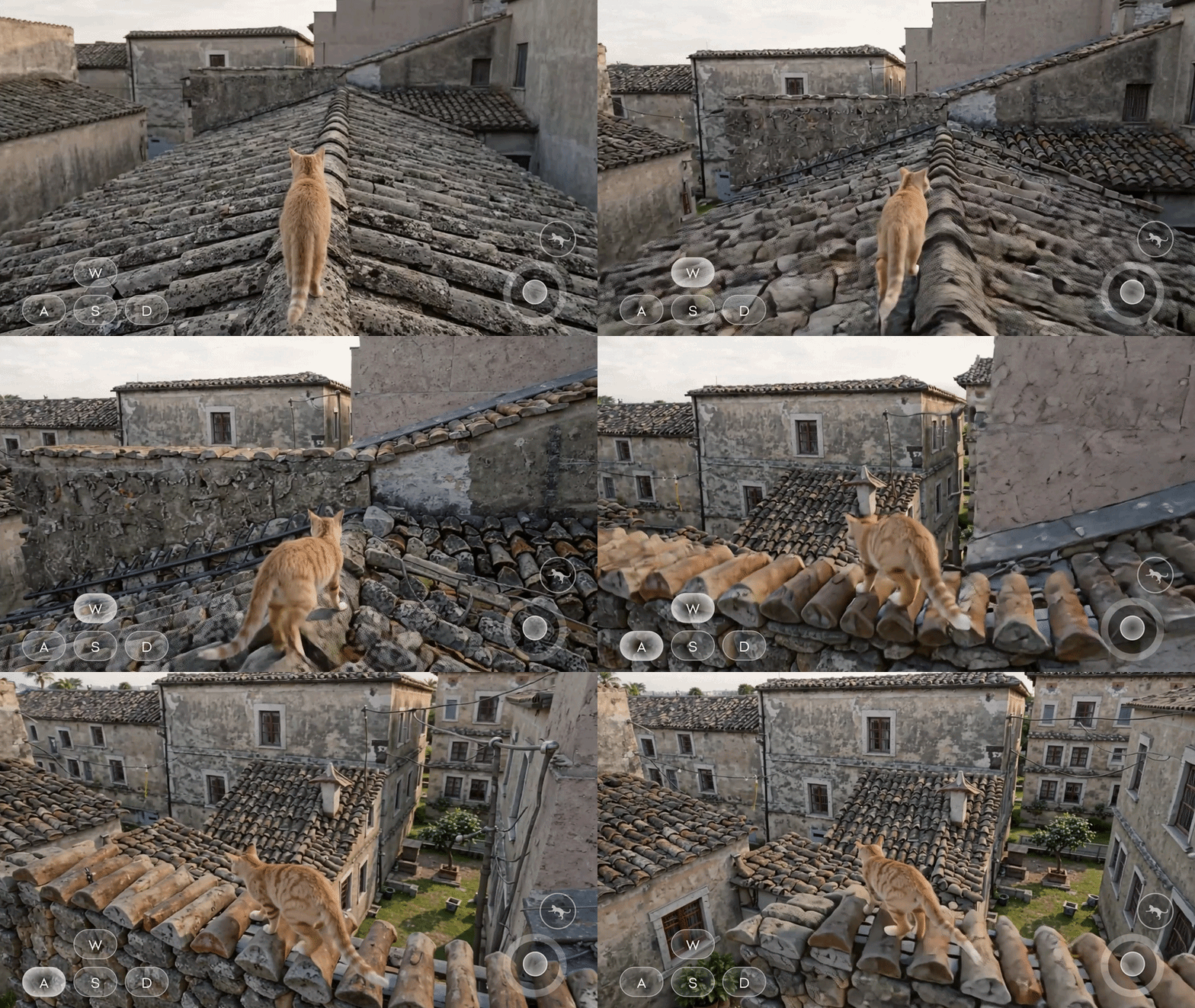
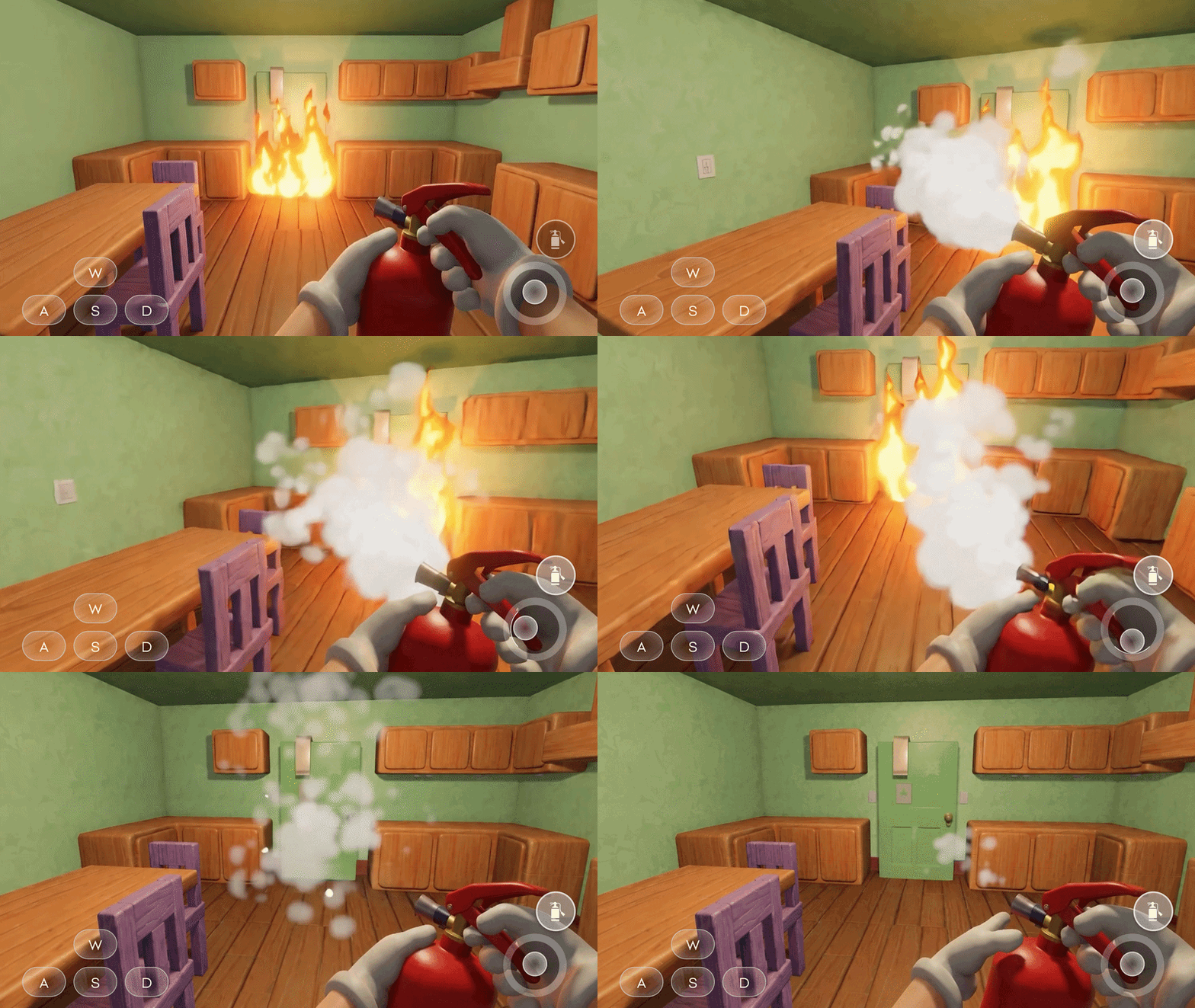
Project Eden's world state exists independently of the camera view. It is not erased when the camera moves, when the user leaves, or when an object moves out of frame.
This allows the system to support long-term exploration inside a consistent environment. Objects can remain where they are. Actions can have lasting effects. The world can continue to exist beyond the current view.
For example, if a user extinguishes a fire, that action is not just a passing visual effect. The fire becomes extinguished in the world state. The world remembers what happened.
2. Reusable and Editable Scenes
Project Eden allows the underlying world state to be read, written, and dynamically modified.
This means user actions can be preserved inside the scene. If a user damages an object, changes part of the environment, or leaves marks behind, later users can see the same changes. The scene does not need to be regenerated from scratch each time. It can be reused, updated, and extended.
This is important for future interactive content creation. Instead of producing disposable clips or isolated scenes, creators could build environments that continue to evolve.

3. Concurrent Multiplayer and Agent Interaction
Project Eden is also designed to support multiple human users and AI agents inside the same underlying world.
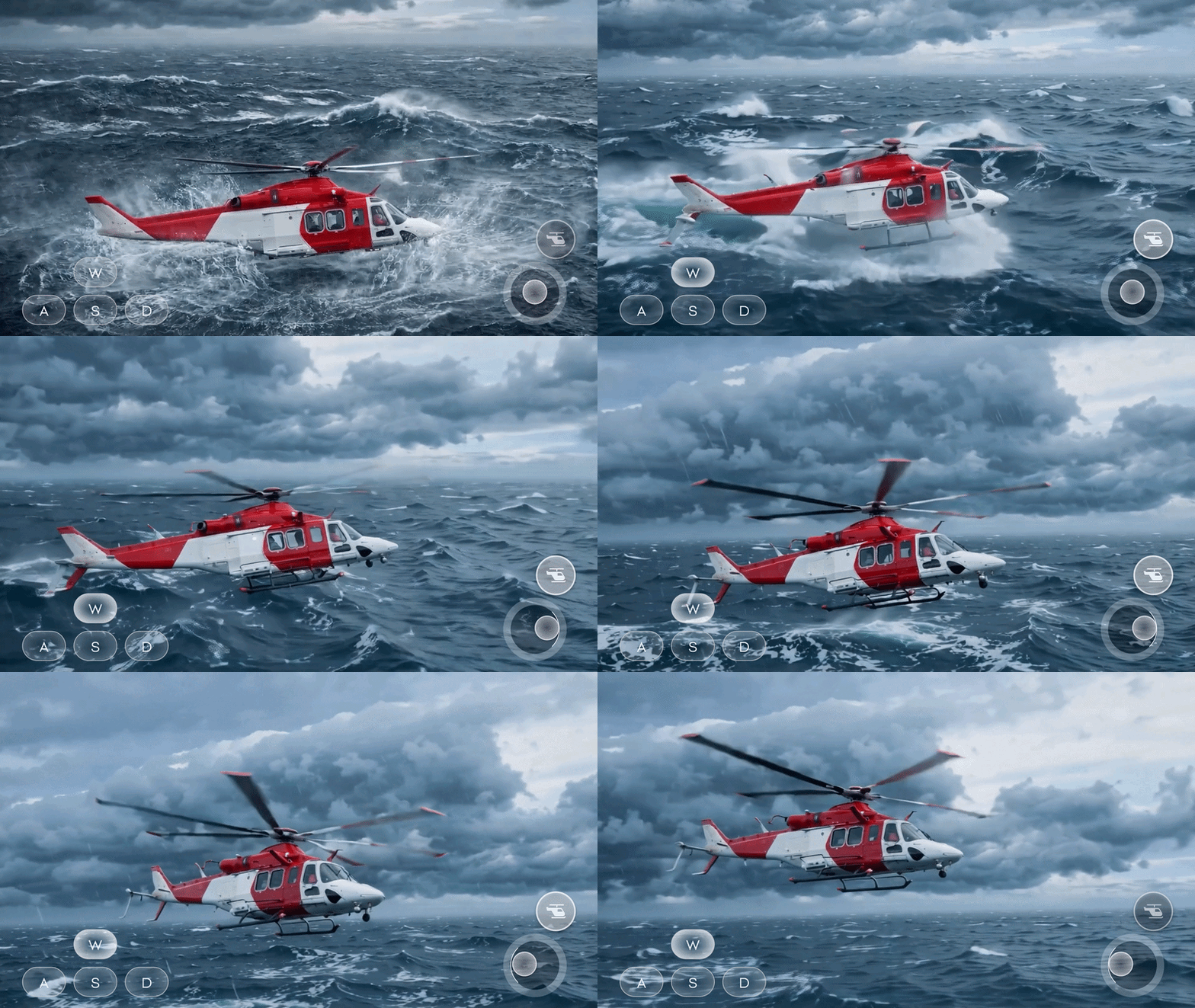
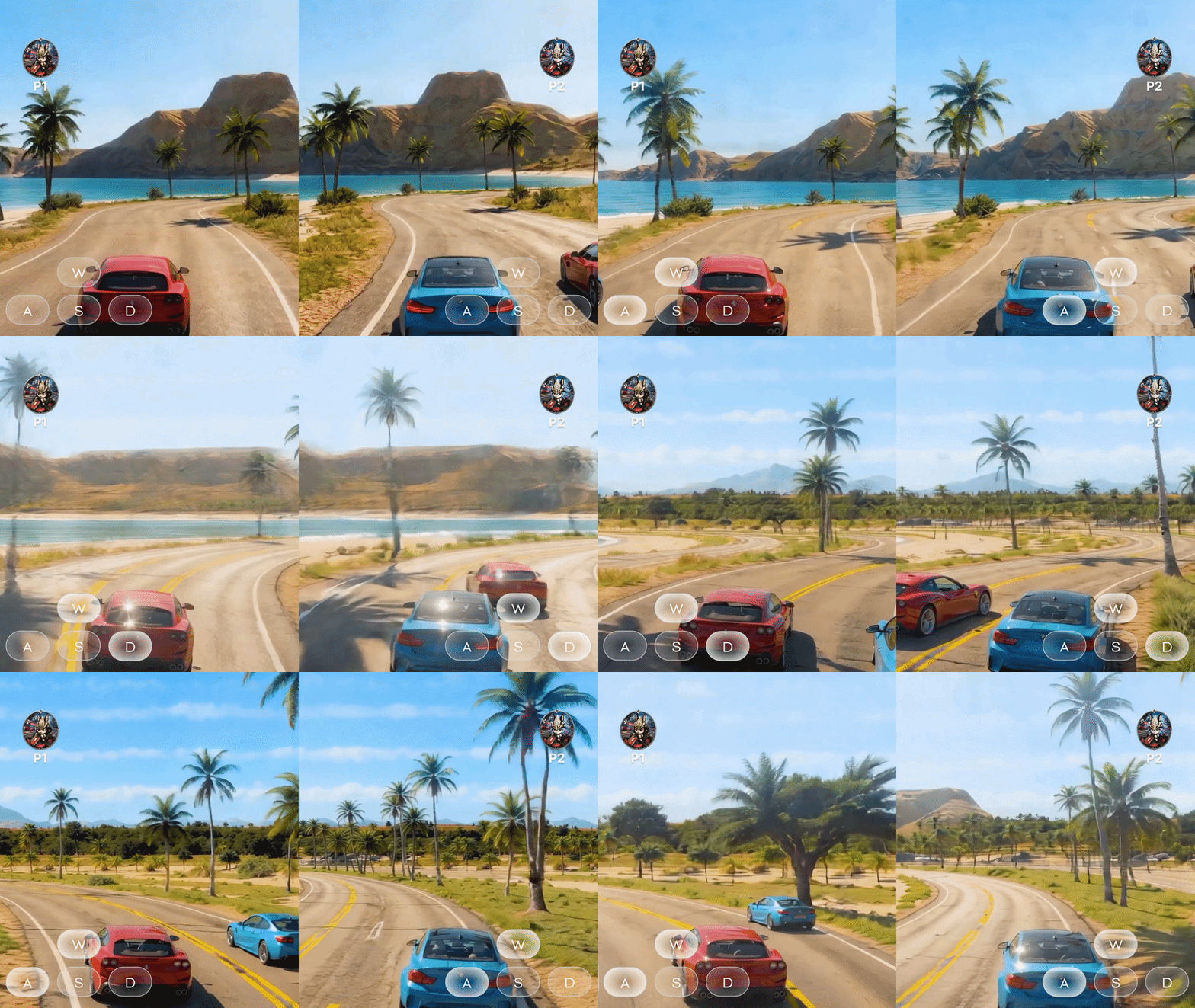
Because state evolution and rendering are decoupled, different users can observe the world from different cameras while still interacting with the same shared state. Each user action updates the same world.
This makes it possible to imagine AI-native multiplayer environments, shared creative spaces, embodied AI training environments, and multi-agent simulation systems.
For example, two cars could race on the same track from different viewpoints.
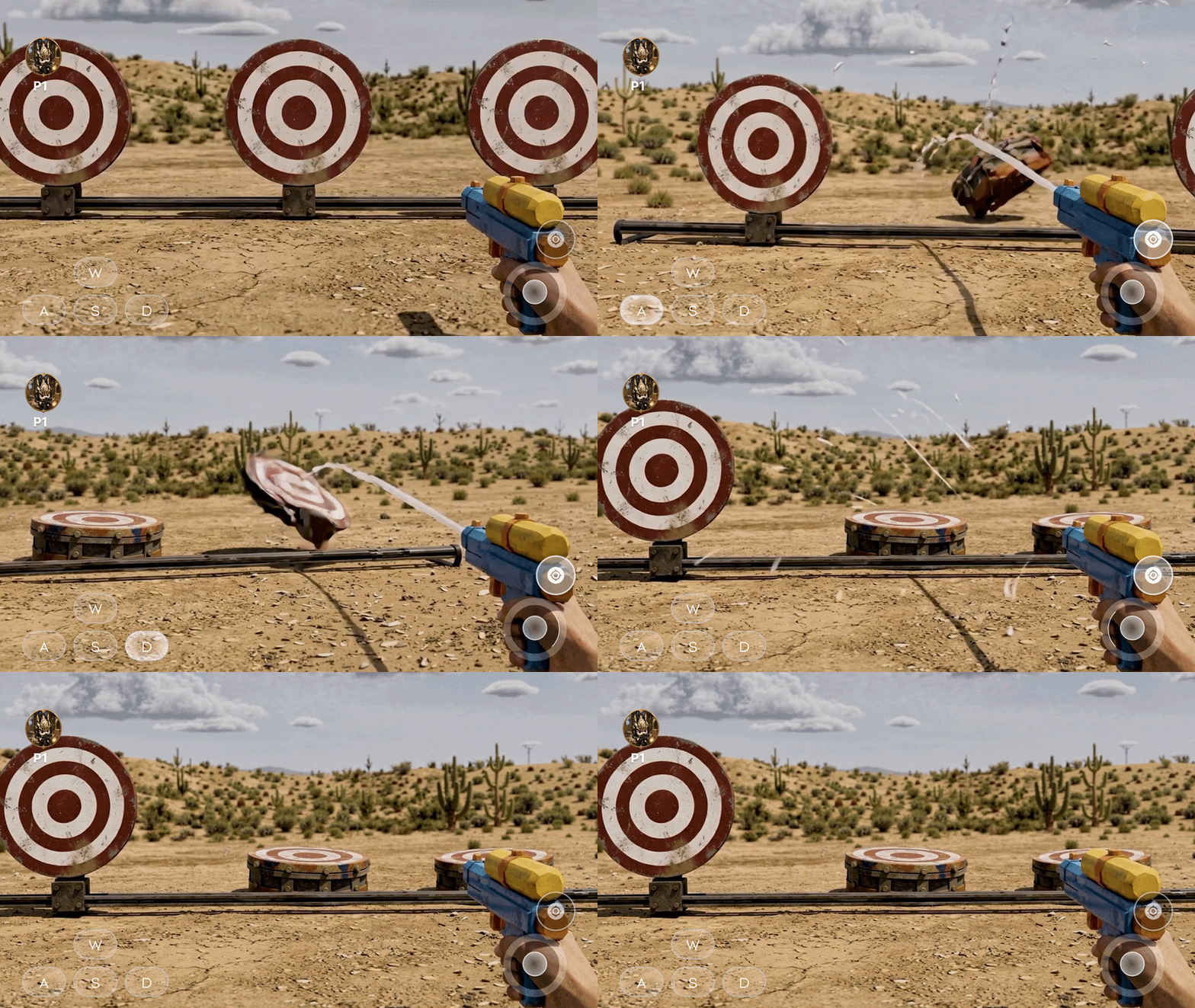
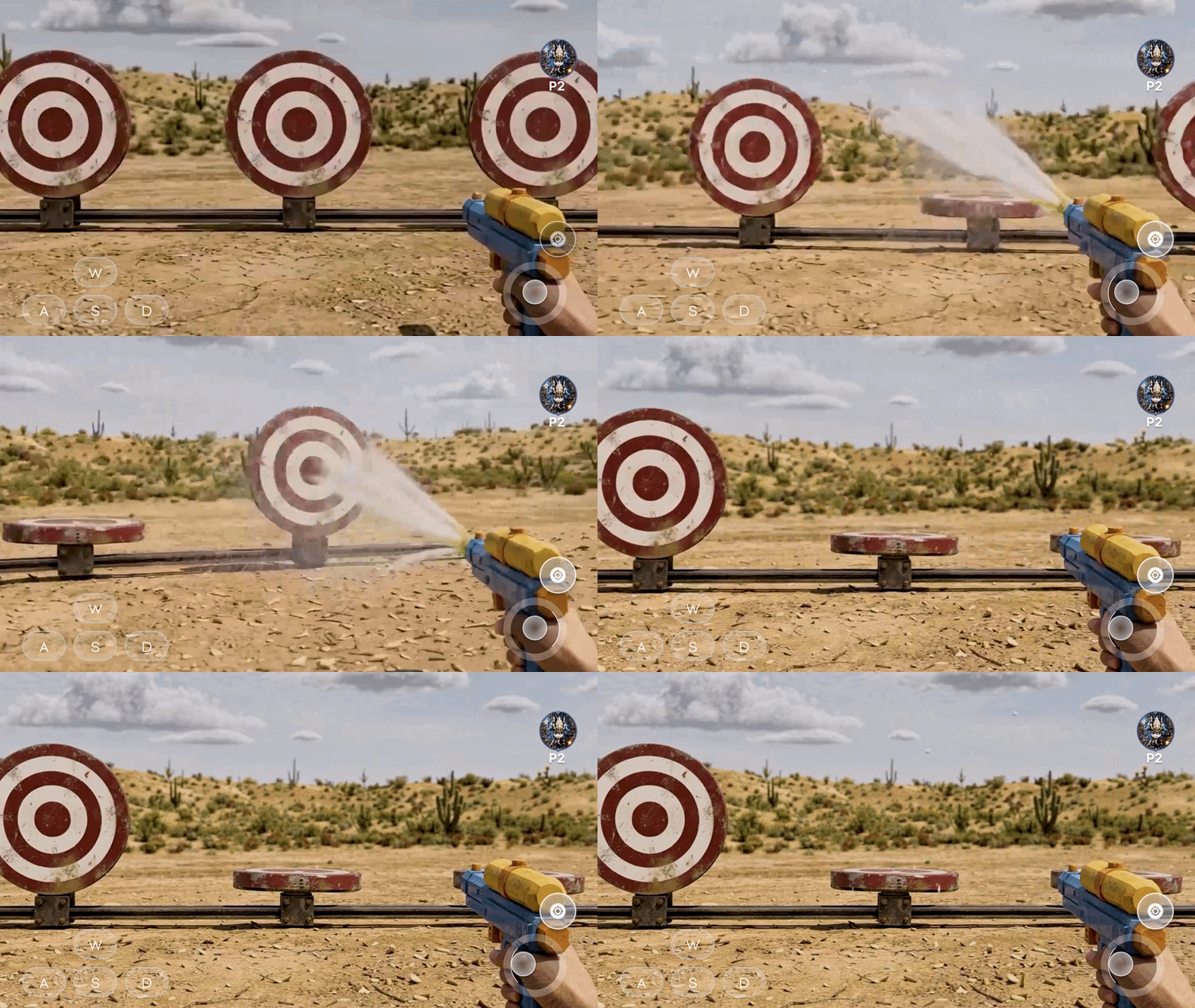
Different players could act inside the same shooting range, and the world could produce different results based on shared rules.
From AI 3D Assets to AI Worlds
Project Eden also connects to VAST's broader AI 3D ecosystem, including Tripo3D, its AI 3D creation product.
Over the past several years, VAST AI Research has continued to push AI 3D generation toward higher quality, faster production, and more usable assets. Tripo3D's 3D generation capabilities help move creative production from visual ideas to spatial assets. With tools such as Image to 3D Model, creators can turn 2D references into 3D models that can be viewed, edited, and used in downstream workflows.
This matters because world creation depends on more than images. It requires objects, environments, structures, and assets that can become part of a larger interactive space.
VAST's long-term direction is to lower the barrier to creating interactive worlds. AI 3D models provide building blocks. Project Eden explores the next layer: worlds that can maintain state, evolve over time, and support interaction.
What Project Eden Could Enable
Project Eden is positioned as a foundation for next-generation interactive content creation. For everyday creators, it points toward AI-native sandbox platforms where users can create shared interactive worlds through natural language and simple actions.
For games, film, VR/AR, digital twins, and virtual spaces, Project Eden suggests a future where AI-generated environments are not only visually rich, but also persistent and responsive.
For research, it could provide simulation environments with physical rules, long-term consistency, and editable states. This is especially relevant for embodied AI training and multi-agent evaluation, where agents need environments that can react, remember, and produce rule-based outcomes.
A world with memory and rules is more than a content format. It becomes a simulation base.
Why This Release Matters
Project Eden matters because it represents a different research path for world models.
It does not reduce world modeling to video generation. It also does not stop at static 3D scene creation. Instead, it treats the world as an evolving structured state that can be rendered, modified, and shared.
This state-first approach creates a stronger foundation for long-term consistency, reusable environments, and multiplayer interaction.
As generative AI continues to evolve, the next frontier may not be only sharper images, longer videos, or faster 3D generation. It may be worlds that remember, respond, and remain consistent over time.
For A1 Art users, the key takeaway is not that this capability is launching inside A1 Art today. Rather, Project Eden shows how one of A1 Art's ecosystem partners is exploring the future of AI-native world creation — a direction that could shape how creators think about images, 3D assets, and interactive environments in the years ahead.
Looking Ahead
Project Eden is still a research preview, and the road toward general-purpose world models remains early. Future work will need to strengthen complex scene reasoning, enrich physical dynamics, expand free-viewpoint exploration, improve fine-grained object interaction, build stronger state transition models, and optimize real-time rendering efficiency.
But the direction is clear.
AI generation is moving from content creation toward world creation. Images, videos, and 3D assets will remain important, but they may become building blocks for something larger: persistent interactive environments with memory, rules, and shared experience.
Project Eden is an early step toward that future. As this innovative world-building tech evolves, creators can enrich their daily content creation alongside a1.art to complete diverse image and video production needs.
The garden has no walls. Welcome to Eden.
Read more
- How to Create Personalized AfroBull Style AI Art for Free? Your Step-by-Step Guide
- Top 5 AI 3D Model Generators in 2026: Which Tool Is Right for You?
- Best Komiko AI Alternatives for Smarter AI Generation in 2026
- How to Generate Realistic AI Robot Sex Images
- How to Create Intense AI Rough Sex Scenes?
- Best AI Kiss Generators for Steamy Couple Videos: 2026 Full Guide
- How to Use AI to Add Inflate Effects to Your Images: A Guide to Creating Viral 3D Art
- How to Turn 2D Photo to 3D Figures Online Free: Your Guide to Creating Models
- 12 Best Malva AI Alternatives for AI Image Generation
- Top 10 Best Femdom AI Generators 2026
Written by

a1.art
Published on
Jun 5, 2026
Share article


