



The AI revolution is reshaping digital content creation, and 3D modeling is no exception. What once required hours of manual work and extensive expertise can now be accomplished in minutes with AI-powered tools. Whether you're building game assets, creating product visualizations, designing AR/VR experiences, or exploring creative concepts, AI 3D generators are making high-quality 3D content more accessible than ever.
As the market continues to evolve, choosing the right platform can be challenging. Some tools focus on rapid concept generation, while others are designed for production-ready workflows and commercial use.
In this guide, we explore five of the leading AI 3D model generators in 2026 and compare their strengths, features, and ideal use cases to help you find the right solution for your projects.
What Makes a Great AI 3D Model Generator?
Not all AI 3D generators are built for the same purpose. Some prioritize speed and accessibility, while others focus on asset quality, animation readiness, or developer integrations.
When evaluating AI 3D tools, the following factors are particularly important:
-
Text-to-3D generation quality
-
Image-to-3D reconstruction accuracy
-
Ease of use and workflow efficiency
-
Output quality and topology
-
Animation and rigging support
-
Export options and compatibility
-
API availability for developers
-
Pricing and scalability
With these criteria in mind, let's look at the top AI 3D generators available today.
1. Tripo – Best Overall AI 3D Generator
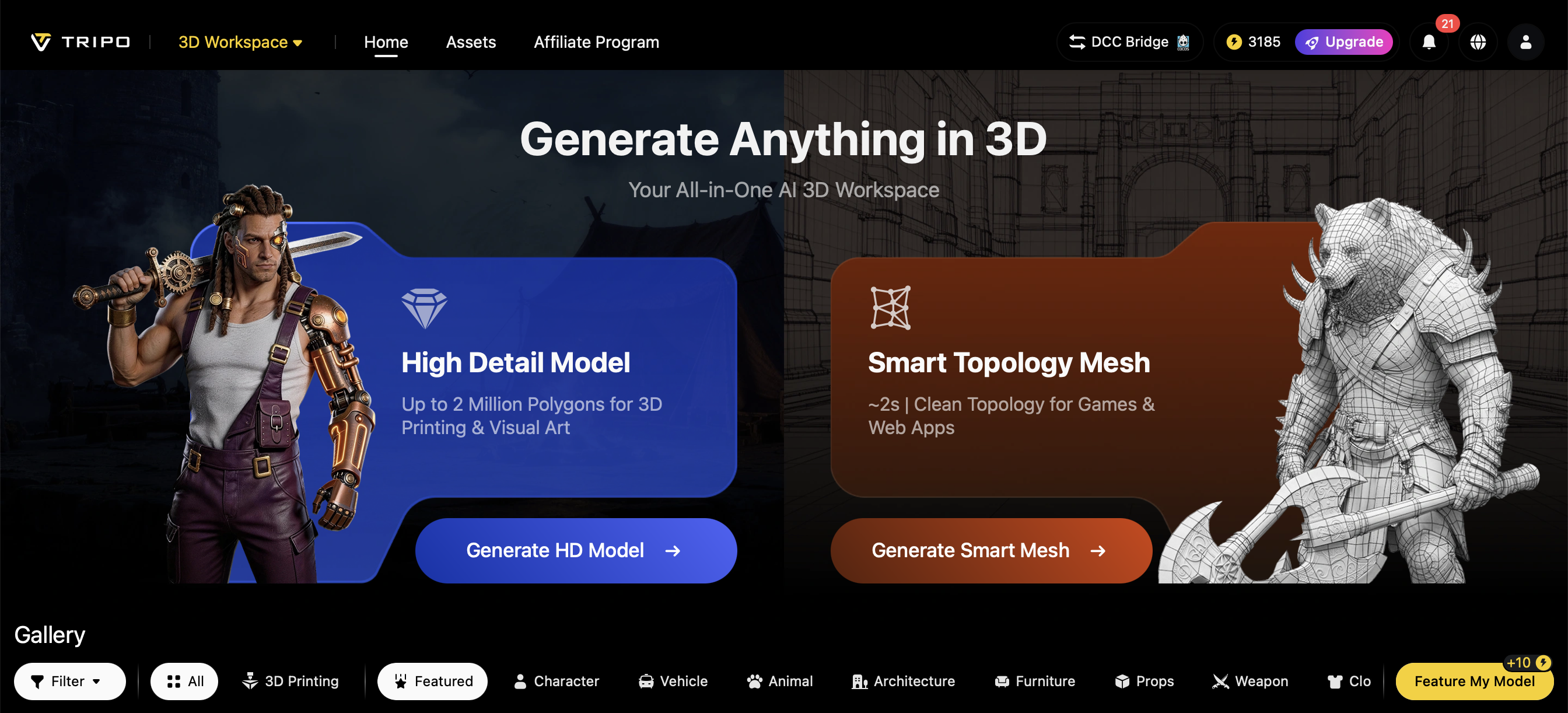
Tripo has quickly established itself as one of the most comprehensive AI 3D generation platforms available. Designed for creators, developers, and studios, it combines speed, quality, and production-oriented workflows into a single solution.
Unlike many AI 3D tools that focus primarily on concept generation, Tripo aims to bridge the gap between idea and production. Users can generate detailed 3D assets from either text prompts or images, then export them for use in game engines, creative projects, and commercial workflows.
Key Features
-
Text-to-3D generation
-
Fast model generation
-
Automatic rigging capabilities
-
Animation-ready assets
-
Developer-friendly API
-
Multiple export formats
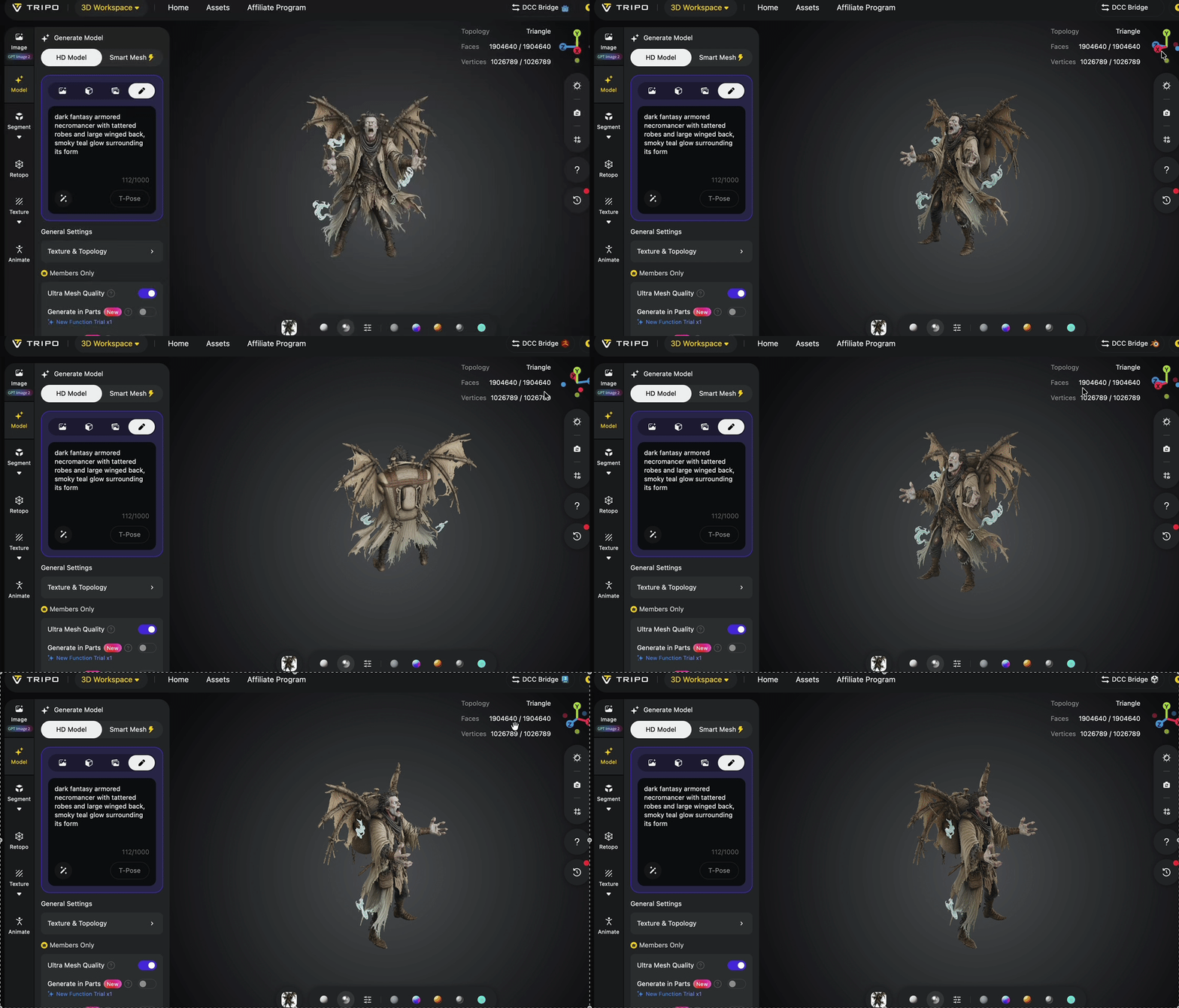
Advantages
One of Tripo's biggest strengths is its ability to produce assets that are closer to production-ready than many competing platforms. This can significantly reduce the amount of manual cleanup and optimization required before deployment.
Its API support also makes it attractive for developers building AI-powered applications, while its intuitive workflow allows creators to generate and iterate on assets quickly.
Best For
-
Game developers
-
Creative studios
-
Product designers
-
AI application builders
-
Professional content creators
For users seeking a balance between generation quality, workflow efficiency, and scalability, Tripo remains one of the strongest options in 2026.
2. Meshy – Best for Rapid Concept Creation
Meshy is one of the most recognized names in the AI 3D space and has built a strong reputation among creators looking for fast ideation and experimentation.
The platform offers both text-to-3D and image-to-3D generation, allowing users to quickly transform ideas into visual assets. Its browser-based workflow makes it particularly accessible to users with little or no 3D modeling experience.
Key Features
-
Text-to-3D generation
-
Image-to-3D conversion
-
AI texture generation
-
User-friendly interface
-
Fast prototyping workflow
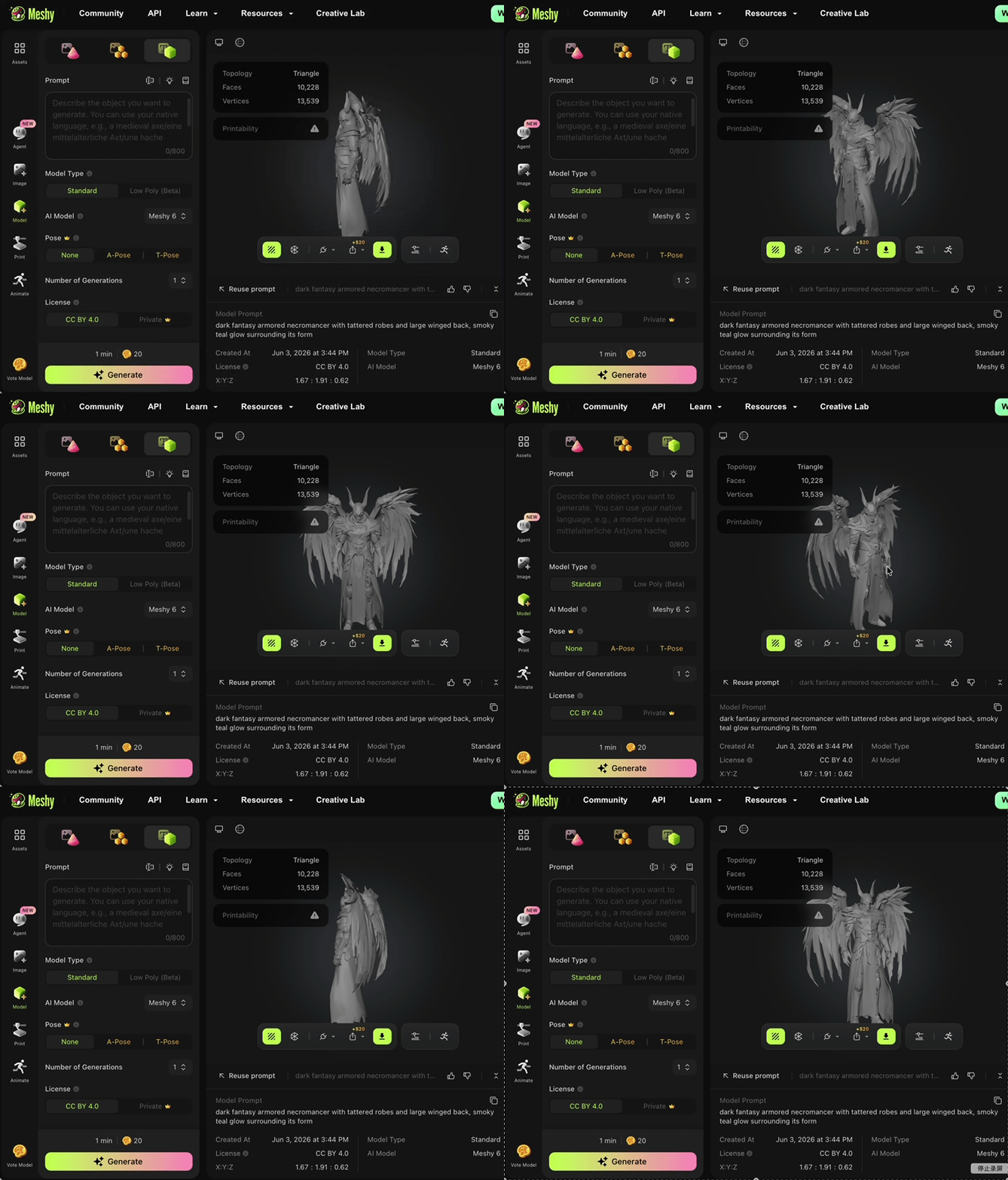
Advantages
Meshy excels at rapid concept creation. Designers and artists can generate multiple variations of an idea within minutes, making it useful during the early stages of product development or creative exploration.
Its large and active user community also contributes to a growing library of tutorials, workflows, and inspiration.
Limitations
While Meshy performs well for concept generation, some assets may require additional optimization before being used in production environments, particularly for game development and animation projects.
Best For
-
Concept artists
-
Independent creators
-
Designers
-
Creative experimentation
3. Rodin – Best for Character Generation
Rodin has become increasingly popular for its ability to generate highly detailed 3D characters. The platform focuses on producing visually impressive models with strong geometric detail and realistic textures.
For creators working on character-centric projects, Rodin offers some of the most compelling outputs currently available in the AI 3D market.
Key Features
-
Character-focused generation
-
Detailed geometry
-
High-quality texture generation
-
Realistic visual output
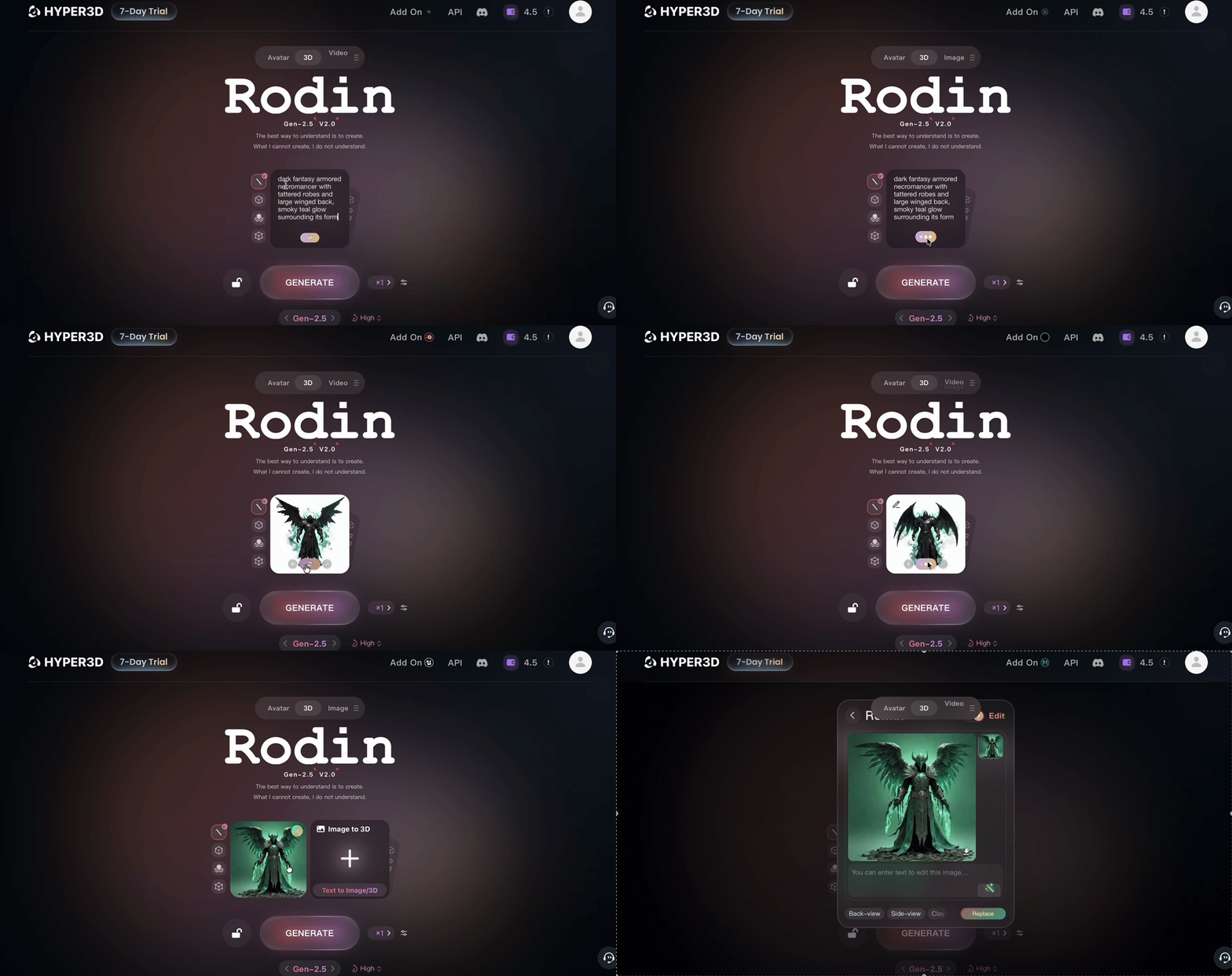
Advantages
Rodin's primary strength lies in visual fidelity. Character models often display strong detail and realistic proportions, making the platform appealing for animation, digital humans, and entertainment projects.
Limitations
Compared to some broader AI 3D platforms, Rodin is more specialized and less focused on end-to-end production workflows.
Best For
-
Character artists
-
Animation creators
-
Entertainment projects
-
Digital human development
4. Hunyuan3D – Best Open-Source AI 3D Solution
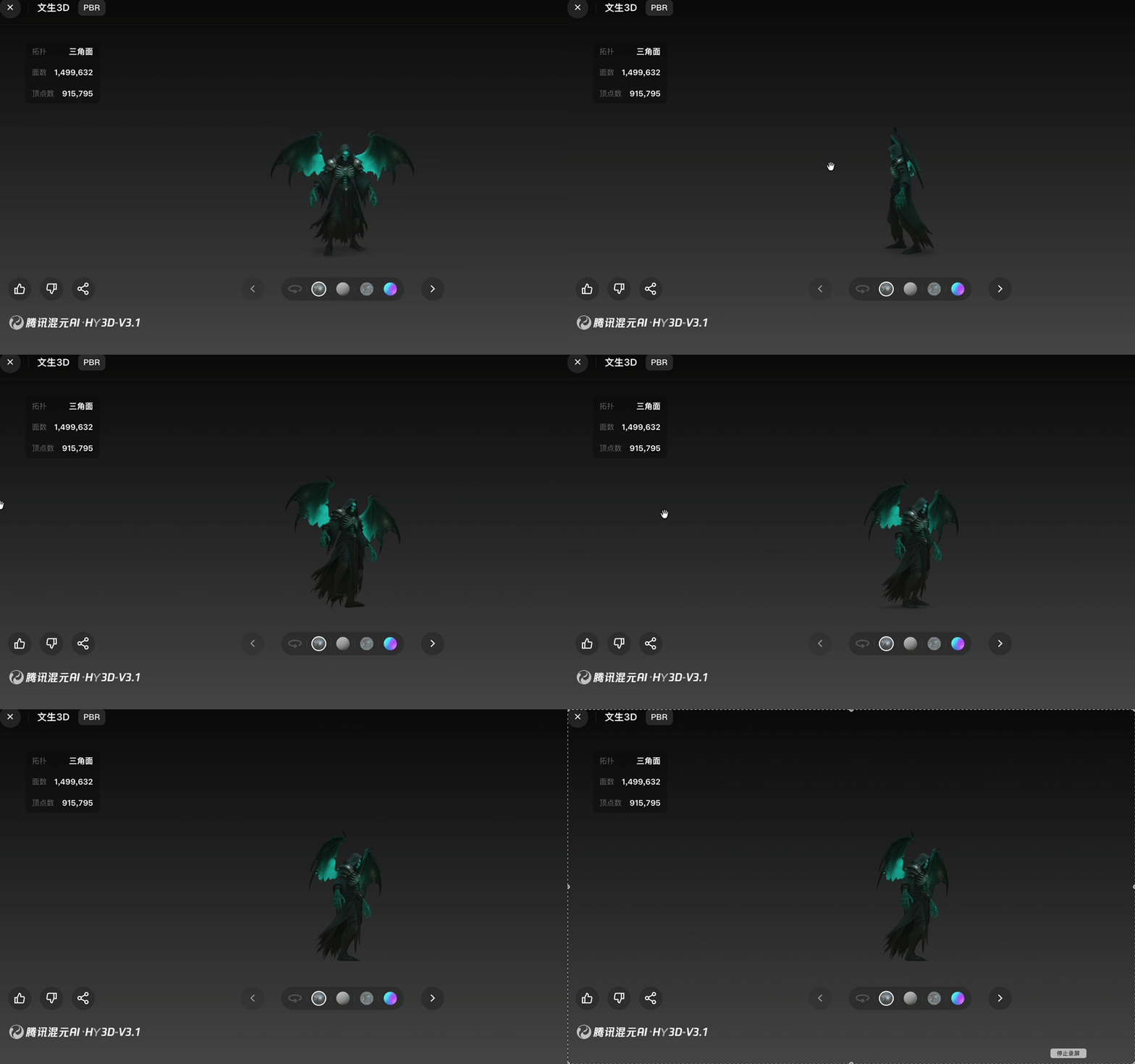
Hunyuan3D represents the growing trend toward open-source AI 3D generation. Backed by a strong research ecosystem, it offers developers and technical teams a flexible framework for experimentation and customization.
Unlike commercial SaaS platforms, Hunyuan3D provides users with greater control over implementation and deployment.
Key Features
-
Open-source architecture
-
Flexible deployment options
-
Research-driven innovation
-
Developer customization
Advantages
For technical teams, the ability to modify workflows and integrate custom pipelines can be extremely valuable. Organizations looking to build proprietary solutions may benefit from the platform's flexibility.
Limitations
The learning curve is significantly higher than many consumer-oriented platforms. Users often require technical expertise to unlock the platform's full potential.
Best For
-
Developers
-
AI researchers
-
Technical teams
-
Open-source enthusiasts
5. Sloyd – Best for Game Asset Creation
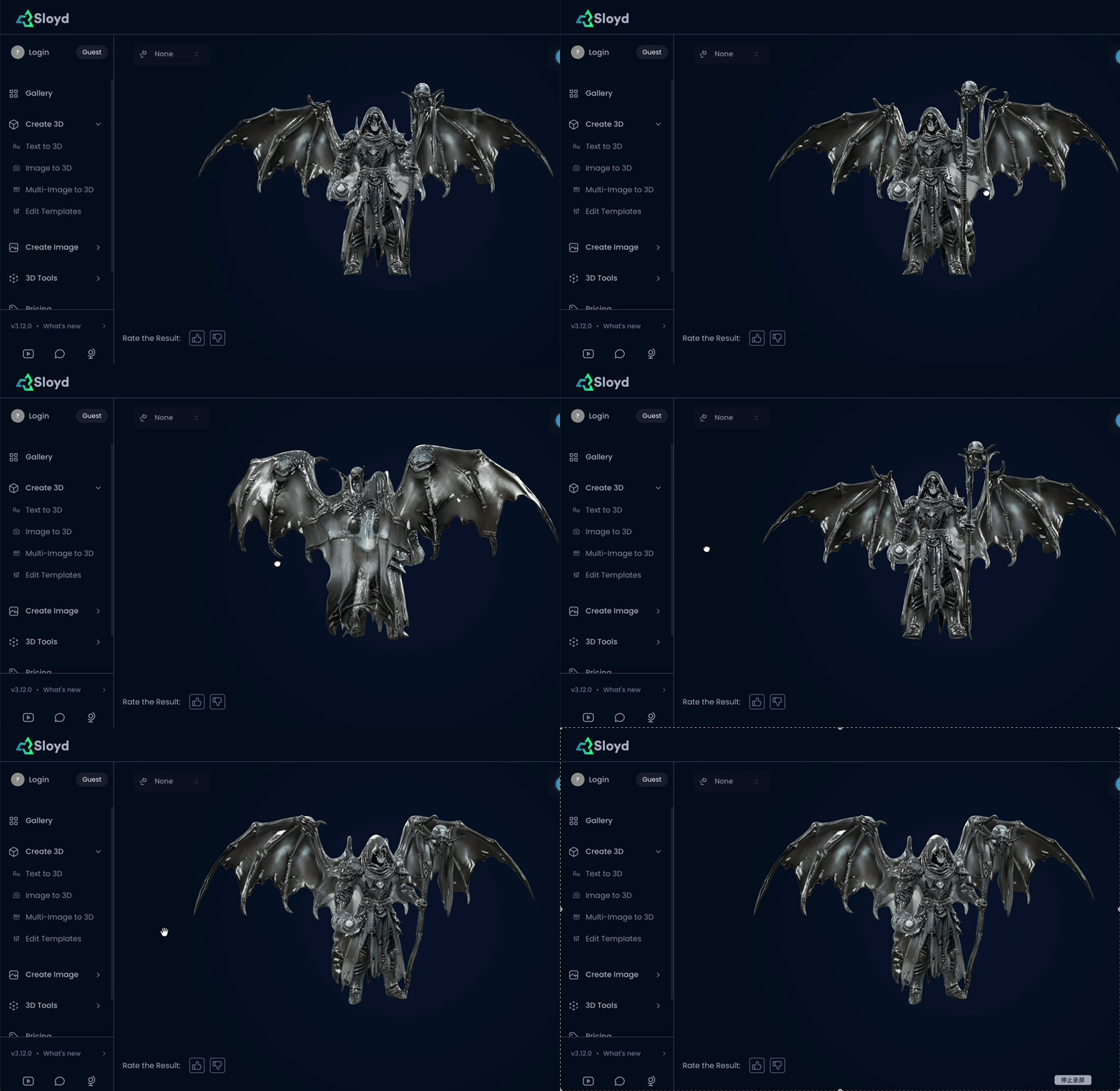
Sloyd takes a different approach by focusing on procedural asset generation. Rather than generating highly detailed artistic models, it specializes in creating practical game-ready assets quickly and efficiently.
This makes it particularly useful for indie developers and small teams that need to build large asset libraries without investing extensive time in manual modeling.
Key Features
-
Procedural asset generation
-
Game-focused workflows
-
Fast asset iteration
-
Low-poly asset creation
Advantages
Sloyd enables rapid production of consistent assets that can fit well into stylized game environments. It is especially useful during prototyping and early-stage development.
Limitations
The platform is less suited for highly realistic visual content compared with AI-first image-to-3D generators.
Best For
-
Indie game developers
-
Mobile game creators
-
Stylized game projects
-
Rapid prototyping
Comparison Overview
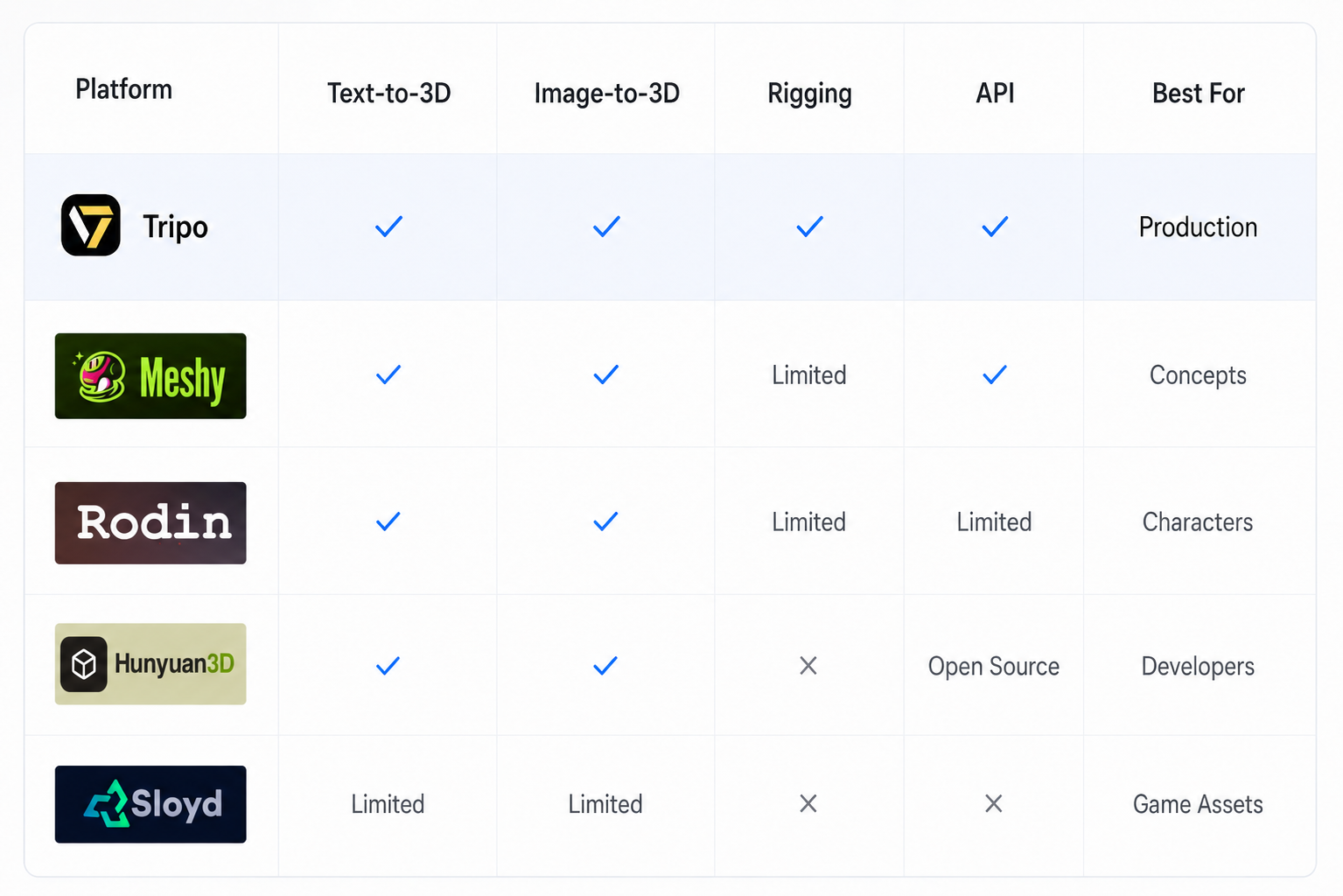
While all five platforms support AI-assisted 3D creation, they cater to different user needs. Tripo stands out as the most well-rounded solution, combining text-to-3D, image-to-3D, rigging, API access, and production-ready workflows in a single platform. Meshy excels at rapid concept generation and creative experimentation, while Rodin is particularly strong for character-focused projects. Hunyuan3D appeals to developers seeking open-source flexibility, and Sloyd remains a practical choice for procedural game asset creation. Ultimately, the best tool depends on your workflow, but for creators and teams looking to move efficiently from concept to production, Tripo offers the most comprehensive feature set among the platforms compared here.
Which AI 3D Generator Should You Choose?
The best AI 3D generator ultimately depends on your goals and workflow requirements.
Choose Tripo if you need production-ready assets, API integrations, and a streamlined workflow that can scale from individual projects to commercial applications.
Choose Meshy if your priority is rapid concept development and creative experimentation.
Choose Rodin if character quality and visual fidelity are your primary concerns.
Choose Hunyuan3D if you prefer open-source flexibility and have the technical resources to customize your workflow.
Choose Sloyd if you're focused on generating game assets quickly and efficiently.
Final Thoughts
AI-powered 3D generation continues to advance at an impressive pace, making professional-quality asset creation accessible to a much wider audience. From game development and product visualization to AR/VR experiences and digital content production, these tools are changing how creators work.
Each platform on this list offers unique strengths. However, for users looking for a balanced combination of generation quality, workflow efficiency, animation readiness, and scalability, Tripo stands out as one of the most complete AI 3D model generators available in 2026.
As AI technology continues to mature, creators can expect even faster workflows, higher-quality outputs, and deeper integrations across the entire 3D production pipeline. Meanwhile, you can complement 3D creation with a1.art, a professional AI drawing tool that delivers high-efficiency, high-definition AI graphic production to enrich your entire digital content creation process.
Read more
- Best Komiko AI Alternatives for Smarter AI Generation in 2026
- How to Generate Realistic AI Robot Sex Images
- How to Create Intense AI Rough Sex Scenes?
- Best AI Kiss Generators for Steamy Couple Videos: 2026 Full Guide
- How to Use AI to Add Inflate Effects to Your Images: A Guide to Creating Viral 3D Art
- How to Turn 2D Photo to 3D Figures Online Free: Your Guide to Creating Models
- 12 Best Malva AI Alternatives for AI Image Generation
- Top 10 Best Femdom AI Generators 2026
- How to Generate AI Sus Pictures Free Online? Ultimate 2026 Meme Guide
- Best Pic to Porn AI Tools for Realistic Photos
Written by

a1.art
Published on
Jun 4, 2026
Share article


