

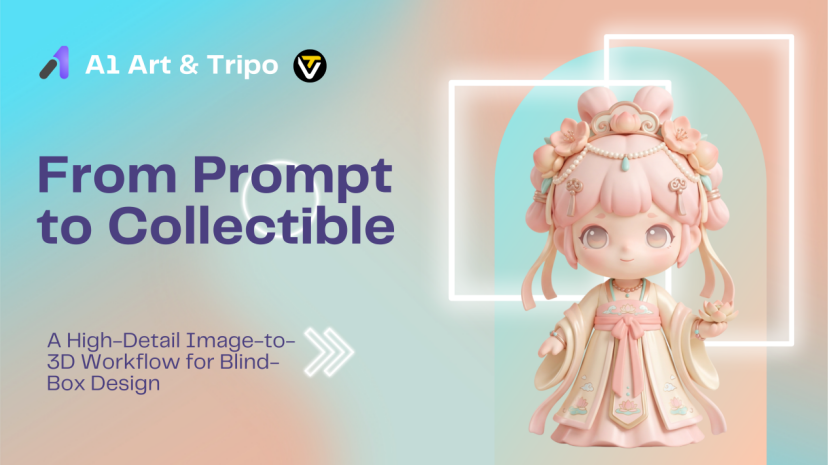
Can a1.art only create image figurines? Tripo 3D helps you get blind box characters.
This test evaluates whether Tripo can turn a single text prompt into a blind-box character that feels like a real 3D collectible rather than just a concept image.
The workflow was tested from text prompt to concept generation and finally to a detailed 3D model, focusing on generation speed, detail preservation, visual consistency, texture quality, and 3D printing potential.
Prompt Setup
The test began with a text prompt designed to generate a cute blind-box character inspired by dreamy Chinese fantasy aesthetics.
Prompt used: “A cute collectible blind-box style character, inspired by dreamy Chinese fantasy aesthetics, oversized head and small body proportions, soft facial features, large expressive eyes, gentle smile, pastel pink and cream color palette, elegant traditional-inspired outfit with delicate accessories, slightly stylized hair ornaments.”
Within seconds, Tripo generated four image concepts from the prompt. Each version showed a different hairstyle, outfit structure, and accessory design, while still following the same core direction: a pink-toned Chinese fantasy collectible figure with a soft, playful blind-box look.
The result demonstrated strong prompt interpretation and visual consistency. Instead of producing unrelated outputs, the four concepts shared a coherent style based on the prompt while still offering enough variation for concept selection.
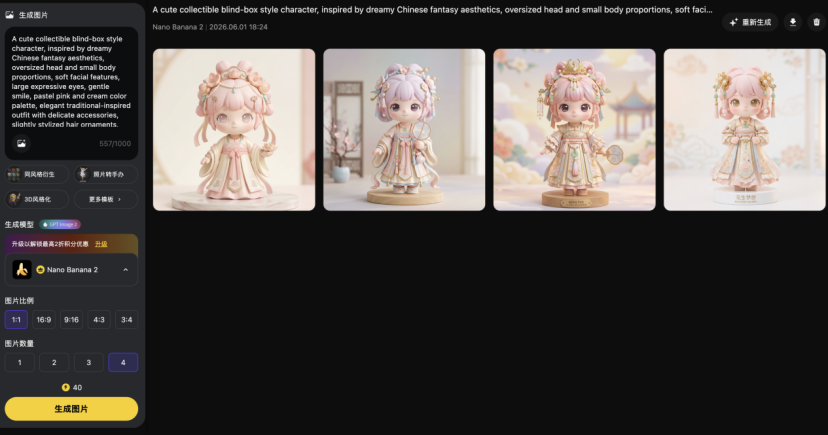
Image-to-3D Generation
Among the four generated concepts, the first design was selected as the final reference image due to its combination of decorative complexity and collectible-style aesthetics. The character featured flower ornaments, pearl-like chains, layered accessories, and lotus-inspired costume details, making it a suitable test case for evaluating image-to-3D reconstruction quality.
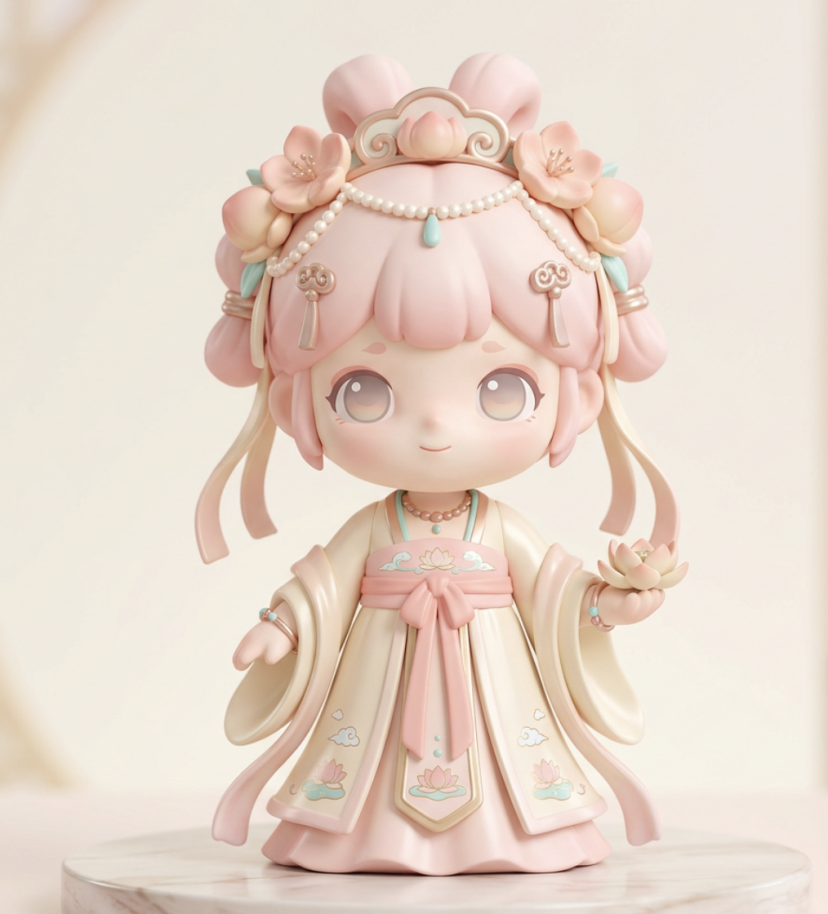
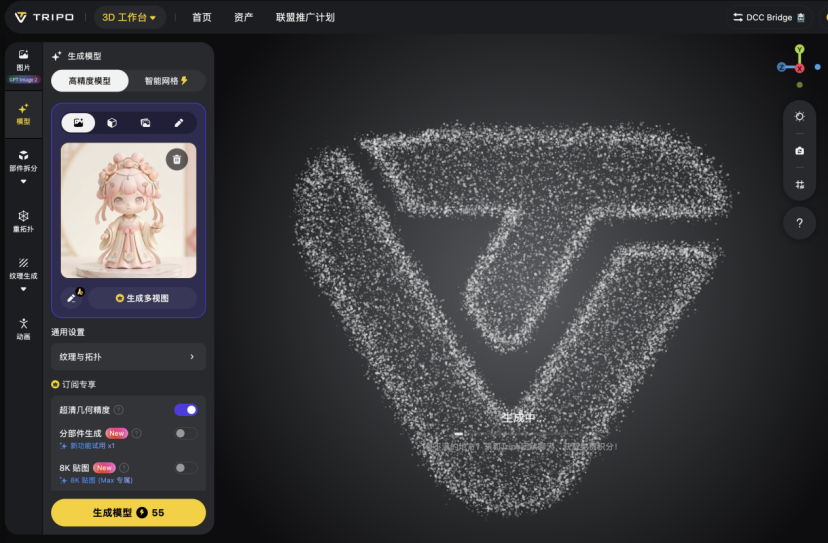
The selected image was uploaded into Tripo's High-Detail Model workflow and processed using the Image-to-3D generation feature.
Generation took approximately two to three minutes. The resulting model contained approximately 1,907,478 triangles and 997,885 vertices, producing a fully textured 3D character while preserving the overall visual identity of the original concept.
The generated output provided a useful benchmark for evaluating several core capabilities, including geometry reconstruction, mesh quality, detail preservation, texture consistency, and downstream usability for collectible design workflows.
High-Detail Model Performance
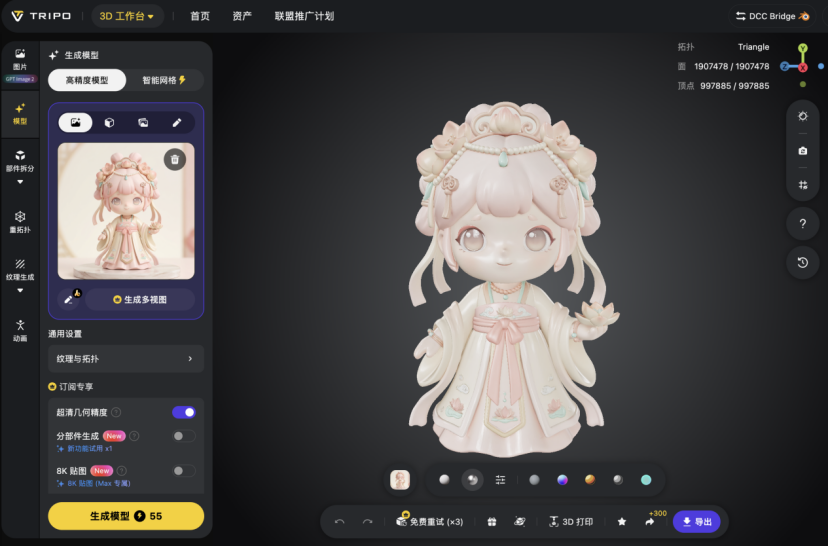
The model was generated using Tripo's High-Detail workflow (v3.1), producing approximately 1.9 million triangles and nearly one million vertices.
The high polygon count was particularly noticeable around decorative areas such as the flower ornaments, pearl chains, tassels, and layered sleeves. Rather than simplifying these elements into a single surface, the generated geometry retained much of the original structure and visual complexity.
For blind-box and collectible character design, this level of detail helps preserve the visual identity of the concept during the transition from image to 3D.
A comparison between the generated model and the original concept image showed that many key visual elements were successfully preserved, including the flower hair ornaments, pearl chains, tassels, layered sleeves, pastel color palette, and lotus-inspired decorative details on the outfit.
One of the most notable results was the side- and back-view reconstruction. Because the source image only provided a single front-facing reference, the generation workflow had to infer missing geometry for areas that were not visible in the original concept.
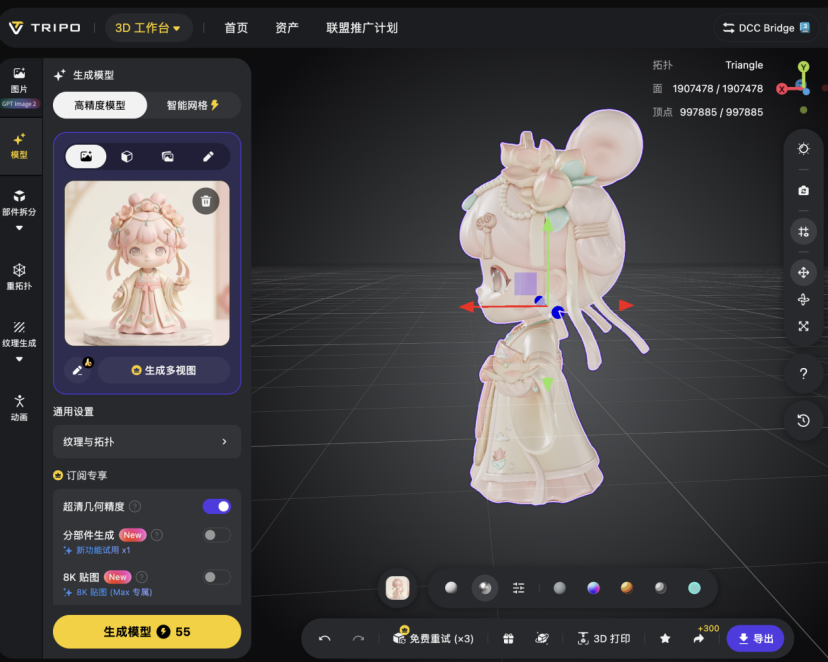
The side-view reconstruction showed good structural separation between the main body and decorative elements. Head ornaments, ribbons, sleeves, and accessories remained identifiable as individual components rather than collapsing into simplified geometry.
As a result, the generated model preserved both the overall silhouette and much of the visual complexity present in the original concept artwork.
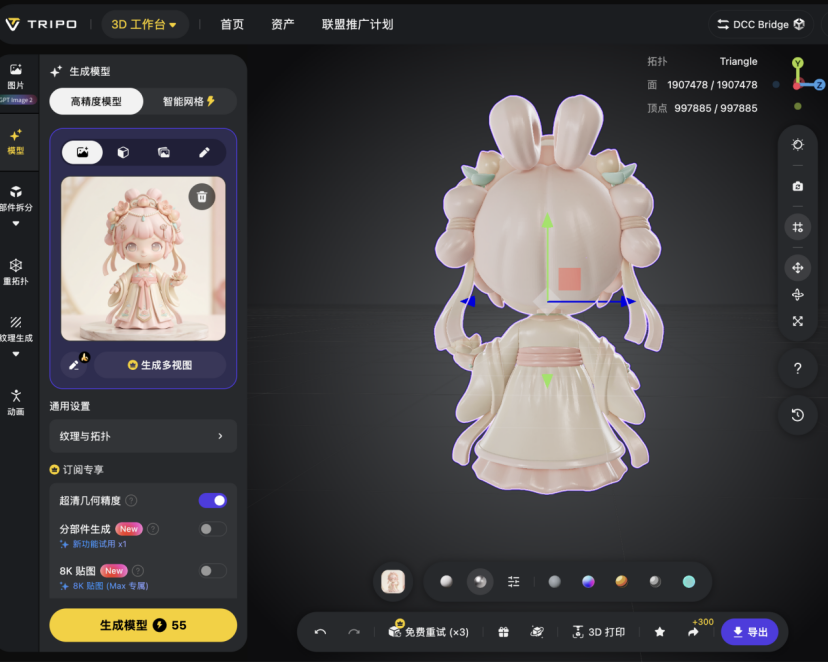
The generated character also included a complete back view with hair buns, ribbons, layered clothing details, and a silhouette that remained consistent with the original design.
This was one of the strongest results of the evaluation because the source image only provided a single front-facing reference. Despite the lack of rear-view information, the reconstruction workflow generated a coherent back view that remained visually aligned with the character's overall design language.
For blind-box and collectible character design, decorative elements play a significant role in maintaining visual identity. During image-to-3D reconstruction, these details are often simplified or lost when information is missing from the source image.
In this test, many of those decorative features remained recognizable across multiple viewing angles. Hair structures, ribbons, layered accessories, and clothing details were reconstructed with sufficient consistency to preserve the overall character design rather than producing a generic rear-facing model.
Mesh Reconstruction and Detail Preservation
The strongest result of the test was detail preservation. Small decorative elements around the head and clothing were carried into the 3D model with a high level of recognizability. Flowers, pearl-like ornaments, ribbons, tassels, and layered sleeves remained visually distinguishable rather than being merged into a single unclear surface.
This was especially important because these are the types of details that often become simplified during image-to-3D reconstruction. Decorative components such as pearl chains, tassels, flower ornaments, and layered accessories can easily collapse into surrounding geometry when a model is generated from a single image.
In this test, most of these elements remained readable. The pearl-like decorations were still distinguishable, the flower ornaments kept their layered structure, and the ribbons maintained their overall shape. While the reconstruction was not perfect, the model preserved enough decorative detail to maintain the original design language of the blind-box character.
The character proportions were also preserved effectively. The oversized head, small body, rounded face, and soft toy-like silhouette all matched the blind-box aesthetic described in the prompt. This made the output feel closer to a collectible figure than a generic 3D character.
The model also avoided a purely flat front-facing interpretation. Although the input image only showed one angle, the generated result included side and back structures that made the character more complete as a 3D object.
Texture Preservation
Geometry reconstruction was only one part of the evaluation. Another important factor was texture preservation.
The generated model retained much of the original color palette, including the soft pink, cream, and light turquoise accents used throughout the character design. Decorative details such as lotus-inspired patterns and accessory colors remained recognizable after generation.
For collectible and toy-design workflows, maintaining texture consistency is often just as important as preserving geometry. In this test, the generated model remained visually close to the original concept rather than appearing as a simplified reconstruction.
3D Printing Potential
Another area evaluated during the test was the model's potential suitability for 3D printing and collectible production workflows.
Based on visual inspection of the generated model, the overall silhouette remained stable across the front, side, and back views. Major structural elements such as the head, body, sleeves, and hair ornaments were connected cleanly, reducing the likelihood of isolated floating components that can create challenges during physical production.
Several decorative elements, including ribbons, flower ornaments, and tassels, appeared slightly thicker than in the original concept image. While this reduced some visual delicacy, the additional thickness may contribute to improved structural stability for downstream printing workflows.
The character design itself is also relatively well suited to collectible-style production. Unlike highly dynamic poses with large overhangs, the figure maintains a compact silhouette, with most decorative elements positioned close to the main body structure. This reduces geometric complexity and supports a more stable overall form.
Before production, a final inspection in dedicated 3D software would still be recommended to verify factors such as thin structures, surface continuity, support requirements, and base stability. However, the generated result already demonstrated characteristics that align with typical blind-box and collectible figure design workflows.
Overall, the generated model appeared significantly closer to a production-oriented collectible figure than a simple 3D reconstruction of a concept illustration.
Limitations and Areas for Improvement
Despite the strong overall reconstruction quality, several limitations were observed during the evaluation.
First, the eye region appeared closer to a textured surface than a fully dimensional feature. While this was not particularly noticeable at normal viewing distances, additional refinement may be beneficial for close-up rendering or production-quality character assets.
Second, the back-view reconstruction, although complete, contained less decorative detail than the front-facing side of the model. This is expected in single-image reconstruction workflows, where rear-view geometry must be inferred rather than directly generated from reference information.
Some decorative elements, including ribbons and smaller accessories, also appeared slightly thicker than in the original concept image. While this may improve structural stability and downstream printability, it reduces some of the visual delicacy present in the source artwork.
These limitations did not significantly affect the overall quality of the generated asset, but they highlight areas where additional manual refinement may further improve the final result depending on the intended use case.
Final Verdict
The evaluation showed that Tripo is particularly effective at transforming a visual concept into a detailed 3D character. In this test, the workflow successfully generated a blind-box style collectible figure while preserving major visual elements, reconstructing side and back views, and maintaining overall design consistency throughout the image-to-3D process.
While the generated asset does not fully replace manual 3D modeling for production-level character creation—especially when precise topology, animation-ready geometry, or highly controlled structures are required—it significantly reduces the time needed to move from concept artwork to a usable 3D asset.
Several core features performed well during the evaluation. The High-Detail Model workflow produced a dense and visually detailed mesh while preserving decorative structures such as flower ornaments, ribbons, tassels, and layered clothing details. Mesh reconstruction maintained recognizable separation between these elements, while texture preservation helped retain the original color palette and visual identity of the concept artwork.
For blind-box and collectible design workflows, the primary challenge is often not generating an attractive illustration, but preserving enough visual information for that illustration to become a three-dimensional object. Flowers, accessories, proportions, and decorative details must survive the transition from concept art to geometry.
Based on the results of this evaluation, the workflow demonstrated a strong ability to preserve design identity throughout that process. This capability ultimately contributes to making a generated character feel closer to a collectible product rather than a generic 3D reconstruction, while professional AI drawing tool a1.art can efficiently create delicate blind-box character 2D concepts to perfectly match Tripo’s 3D workflow and complete high-quality collectible design.
- How to Generate LGBTQ Pride Month AI Art with Rainbow Effects
- Top 10 AI MLP Generators to Create Your Own Pony Characters
- Partner Spotlight: VAST AI Research Introduces Project Eden
- How to Create Personalized AfroBull Style AI Art for Free? Your Step-by-Step Guide
- Top 5 AI 3D Model Generators in 2026: Which Tool Is Right for You?
- Best Komiko AI Alternatives for Smarter AI Generation in 2026
- How to Generate Realistic AI Robot Sex Images
- How to Create Intense AI Rough Sex Scenes?
- Best AI Kiss Generators for Steamy Couple Videos: 2026 Full Guide
- How to Use AI to Add Inflate Effects to Your Images: A Guide to Creating Viral 3D Art

a1.art
Jun 8, 2026


